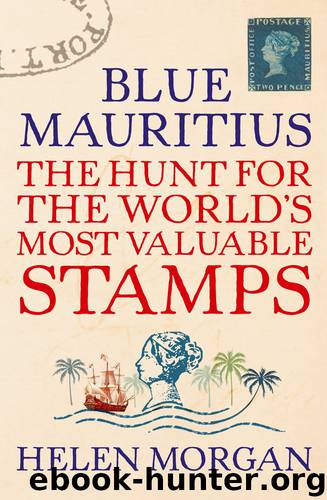
Blue Mauritius by Helen Morgan
Author:Helen Morgan
Language: eng
Format: epub
Publisher: Atlantic Books
Published: 2015-04-27T11:10:47+00:00
Fred Melville’s Rare Stamps: How to Recognise Them, London, 1922, featuring, undoubtedly, a ‘Post Office Mauritius’ on the cover.
The Australian Stamp Journal had been told that a woman in Perth, Western Australia, claimed ‘she had originally lived in Mauritius, and many years ago had the stamp given to her with an injunction to take care of it as it might prove of value’. A respected Perth philatelist, contacted about the poor specimen (the word office was heavily obscured), had the stamp photographed and sent both stamp and photograph to London. Major Evans was the expert consulted. He was sure, even from an examination of the photograph, that it was not a ‘Post Office’, but a later impression of the ‘Post Paid’, wondering in his musings in Stanley Gibbons Monthly Journal why the leading philatelists of Perth had not consulted a copy of the Royal Philatelic Society’s book on British Colonial stamps, which would have sorted out the matter easily. They cannot have owned the book, which invoked the dry rider from the Major, ‘This of course is another matter.’
While none of these rumoured finds ultimately proved to be genuine, they demonstrated the grip on the public imagination that such stories as the schoolboy finds earlier in the century – and the pecuniary rewards attached to them – had attained. Philatelic journalist Fred Melville, writing in 1911, noted that a collector would ‘have to loosen wide the strings of a bounteously filled purse’ to possess the earliest issues of Mauritius (both the ‘Post Office’ and the ‘Post Paid’) and other rare stamps, such as the first issue of British Guiana and the Hawaiian ‘Missionaries’.
Although it was now acknowledged that there were rarer stamps than the ‘Post Office’, the Mauritian stamps were deemed to possess a certain rare quality – ‘as examples of a genuinely necessary issue, small in quantity’ – and to Melville and most of the world’s philatelic community, they would ‘always be looked upon as the ultimate, even if seldom attained, goal of the Philatelist’. Or, as Melville put it another way, summing up the position the ‘Post Office’ stamps had attained in the pre-war years, ‘Incomparable as regards romantic interest and actual value, the first two stamps of Mauritius have been, ever since their discovery in the ’sixties, the desiderata of every collector.’
Apart from the rumoured finds in 1913, there were no fresh discoveries of genuine ‘Post Office’ stamps and no specimens changed hands for another five years. The best of them had already been locked away by long-term specialist collectors, their desires well satisfied: Ferrary now had four, Duveen and Manus each had two, Worthington in America had three and King George V was content with specimens of both values.
Stories of finds, even the possibilities of finds, and musings on stamp hunting would always fill the columns of the philatelic press, but they were very common in these lean ‘Post Office’ years. Bonar’s find and the subsequent price fetched were usually trotted out as an encouragement. Some
Download
This site does not store any files on its server. We only index and link to content provided by other sites. Please contact the content providers to delete copyright contents if any and email us, we'll remove relevant links or contents immediately.
| Africa | Americas |
| Arctic & Antarctica | Asia |
| Australia & Oceania | Europe |
| Middle East | Russia |
| United States | World |
| Ancient Civilizations | Military |
| Historical Study & Educational Resources |
The Sympathizer by Viet Thanh Nguyen(4408)
The Rape of Nanking by Iris Chang(4230)
World without end by Ken Follett(3485)
Ants Among Elephants by Sujatha Gidla(3476)
Blood and Sand by Alex Von Tunzelmann(3212)
Japanese Design by Patricia J. Graham(3184)
The Queen of Nothing by Holly Black(2616)
City of Djinns: a year in Delhi by William Dalrymple(2565)
Foreign Devils on the Silk Road: The Search for the Lost Treasures of Central Asia by Peter Hopkirk(2474)
India's Ancient Past by R.S. Sharma(2464)
Inglorious Empire by Shashi Tharoor(2450)
Tokyo by Rob Goss(2438)
In Order to Live: A North Korean Girl's Journey to Freedom by Yeonmi Park(2396)
Tokyo Geek's Guide: Manga, Anime, Gaming, Cosplay, Toys, Idols & More - The Ultimate Guide to Japan's Otaku Culture by Simone Gianni(2382)
India's biggest cover-up by Dhar Anuj(2365)
The Great Game: On Secret Service in High Asia by Peter Hopkirk(2358)
Goodbye Madame Butterfly(2261)
Batik by Rudolf Smend(2193)
Living Silence in Burma by Christina Fink(2081)
